
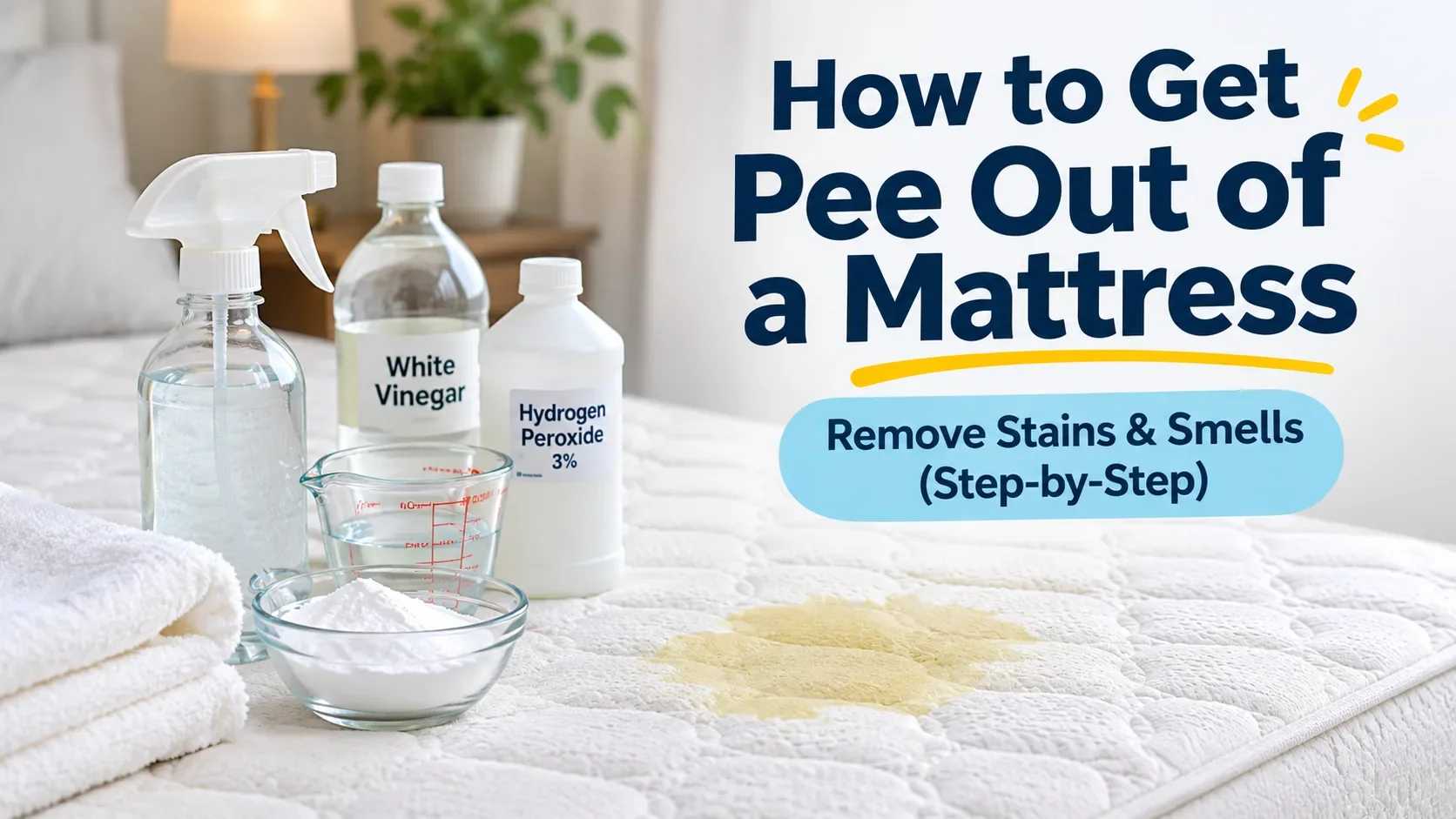
You pull back the sheets and see a wet spot on the mattress. Maybe your child had an accident overnight. Maybe the dog jumped onto the bed. Or maybe you found an old yellow mark and realized the smell never really went away.
Here's what matters most: remove as much urine as you can, use only a cleaning method your mattress allows, and dry it completely. The right next step depends on whether the urine is still wet, already dry, or trapped deeper inside the bed.
Need the answer now?
How to get pee out of a mattress quickly
- Strip the bed. Remove wet sheets and wash them according to their care labels.
- Blot, don't scrub. Press clean, dry towels into the wet spot. Switch towels until little moisture transfers.
- Check the mattress care label. If spot cleaning is permitted, apply a small amount of a compatible urine-cleaning product to a cloth and gently treat the surface, following the product directions.
- Blot away residue. Avoid pouring, soaking, or steaming the mattress.
- Dry thoroughly. Run a fan, improve airflow, and leave bedding off until the mattress is dry. If the odor remains or the mattress is deeply soaked, see the troubleshooting guide below.
For memory foam, latex, and mattresses with restrictive care labels, skip liquid treatments unless the manufacturer explicitly permits them.
What you'll need—and what to check first
Start with a few clean, absorbent towels, disposable gloves if you prefer, a fan, and access to the mattress manufacturer's care instructions. You may also need a urine-specific upholstery cleaner that is approved for your mattress material. A waterproof mattress protector is useful afterward, but it won't fix an existing odor.
A mattress isn't a washable rug. Foam and padding can hold moisture well below the fabric, so a treatment that makes the surface look clean can still leave the interior wet. If the mattress is already heavily saturated, adding more liquid is rarely a good first move.
How to get fresh pee out of a mattress
When the accident just happened, your best advantage is that some of the liquid may still be near the surface. Work on absorption first, not stain removal.
- Remove everything wet. Take off sheets, blankets, and any washable mattress protector. Keep soiled fabric away from clean bedding and wash according to the label.
- Press with dry towels. Lay a folded towel over the wet area and press firmly. Lift, reposition, and repeat with a dry section. Don't rub: rubbing spreads the mess and may drive liquid farther into the cover.
- Identify the mattress material. Find the care tag or model instructions. If the manufacturer permits a specific spot-cleaning method, follow it rather than a generic internet recipe.
- Treat only what you can safely reach. For a compatible product, use the smallest amount directed, preferably applied to a cloth when the label allows. Work from the outside of the mark inward. Avoid saturating the foam.
- Remove any permitted cleaner residue. Follow the product's directions for blotting or rinsing; don't add repeated wet passes unless instructed.
- Air-dry before remaking the bed. Direct a fan across the surface and improve ventilation. Do not put sheets or a protector back on while the mattress is damp.
How do you know you're making progress? Fresh towels stop picking up moisture, the surface no longer feels cool or clammy, and there is no noticeable odor after the mattress has fully dried. These checks can't prove that deep layers are dry, so use extra caution after a large accident.
How to get dried pee out of a mattress
Found the accident the next morning—or several days later? You're dealing with residue that has had time to settle into the cover and possibly the layers below it. The goal is to treat what is reachable without soaking the mattress to chase a stain.
For an old or dried urine spot
- Check the care instructions. Confirm whether the mattress allows a spot-cleaning product and whether that product is suitable for the cover and foam beneath it.
- Check for moisture or mold first. If the mattress still feels wet, has visible mold, or smells strongly musty, don't add cleaner. See the replacement section below.
- Spot-test an approved cleaner. A urine-specific product may be an option if its label permits mattress use. Test for discoloration and changes to the fabric.
- Follow the stated dwell time. Let the product work only as instructed. Avoid the common advice to drench a mattress so the cleaner reaches every layer.
- Blot and dry completely. Remove residue according to the product directions, ventilate, then inspect the result after drying.
Some yellow discoloration may remain even after the source of an odor has improved. A stain that's lighter isn't necessarily a mattress that's fully clean inside.
What about hydrogen peroxide for old yellow pee stains?
Household 3% hydrogen peroxide can lighten certain stains, which is why it appears in so many online cleaning guides. But it can also bleach or discolor fabric and may be unsuitable for foam, latex, adhesives, or a mattress cover. Don't assume a peroxide recipe is safe just because it worked on someone else's mattress. Use it only if your mattress manufacturer permits it, and never combine it with vinegar or other cleaning chemicals.
In a published single-mattress comparison, Apartment Therapy reported that a peroxide-based treatment improved the visible stain more than the vinegar or enzyme treatment it tried. That's one person's informal test—not evidence that peroxide reliably removes deep urine residue or is safe on every mattress.
How to get pee smell out of a mattress—even after cleaning
It's frustrating when the stain looks better but the smell comes back as soon as you lie down. Usually, that means the surface appearance and the underlying odor are telling two different stories.
| What you're noticing | Possible explanation | Safer next step |
|---|---|---|
| Looks clean but still smells | Urine residue may remain below the cover | Check material compatibility before one targeted treatment; assess deep contamination |
| Smell worsens when humid | Odor may be more noticeable with moisture or warmth | Confirm full drying and inspect for dampness |
| Strong fragrance plus urine smell | A scented product may have masked the odor | Avoid layering more fragrance; address the source |
| Musty odor or visible spots | Possible moisture damage or mold | Stop wet cleaning and seek appropriate assessment |
| Same spot repeatedly soiled | Accumulated contamination may be deeper | Consider whether replacement is more practical |
If the mattress is dry and the manufacturer allows it, a urine-specific enzyme cleaner may help with some odor-causing residues. Follow the product label, including its material restrictions and application amount. Many enzyme products require a particular contact time; using more liquid than permitted is not a shortcut.
What about baking soda? It may reduce some surface odors, but it doesn't reliably remove urine from deep foam and isn't a disinfectant. Fine powder can also be unsuitable for some vacuum cleaners. Check your vacuum's instructions before using it on a mattress.
Vinegar vs. baking soda vs. enzyme cleaner vs. peroxide
There isn't one best product for every accident. These methods tackle different parts of the problem, and some aren't compatible with certain mattresses.
| Method | Where it may help | Important limitation |
|---|---|---|
| Enzyme urine cleaner | Some urine-related residue and odor, if approved for the surface | Results vary; labels may require moisture or contact time a mattress can't safely tolerate |
| White vinegar solution | Some light surface residue and odor | Not a reliable disinfectant; liquid can soak into foam; manufacturer may prohibit it |
| Baking soda | Some surface odor management | Doesn't extract deep urine; fine powder can affect some vacuums |
| 3% hydrogen peroxide | May lighten certain visible stains | Can bleach fabric and damage some materials; stain removal is not deep odor removal |
| Fragranced spray | May temporarily change how the mattress smells | Doesn't necessarily remove urine residue |
Don't mix vinegar and baking soda expecting a stronger cleaner. Their reaction produces fizz, but also neutralizes much of their original acid/base action. And never mix peroxide with vinegar in the same container, or bleach with other cleaners.
How to get cat pee or dog pee out of a mattress
Pet accidents can be especially stubborn, and pets may return to a spot that still smells familiar to them. Start the same way as any fresh accident: strip the bed, blot thoroughly, and check the mattress care instructions.
Cat pee on a mattress
Cat urine can leave a strong, lingering odor. If your mattress permits a urine-specific enzyme product, choose one whose label covers cat urine and the mattress material. Don't pour it into memory foam in an attempt to reach deep residue. If the cat repeatedly urinates outside the litter box, ask a veterinarian about possible medical or behavioral causes.
Dog pee on a mattress
For dog urine, blot fresh liquid first, then consider a mattress-compatible product labeled for dog urine. Dry thoroughly and protect the bed with a washable waterproof cover. If accidents are new or frequent, a veterinary check may be appropriate.
For more day-to-day pet cleanup ideas, see our guide to keeping your house clean with dogs.
How to clean urine from memory foam, latex, or a hybrid mattress
Material matters as much as the stain. Some beds have thick, absorbent foam layers that are hard to dry once wet; others have coils beneath foam or fiber padding. The top cover may also have its own care restrictions.
| Mattress type | What to watch for | General approach |
|---|---|---|
| Memory foam | Absorbs and retains liquid; some brands forbid wetting foam | Blot immediately; use only manufacturer-permitted spot treatment |
| Latex | Care rules vary; chemicals and moisture may be restricted | Check brand instructions before any liquid product |
| Hybrid | Foam and fabric above coils can still trap moisture | Avoid soaking; don't assume coils make extraction safe |
| Innerspring | Padding and cover can absorb liquid even with less foam | Use the specific manufacturer's care directions |
| Unknown type | Hidden materials and unknown restrictions | Stick to absorption and drying until you identify the model |
Don't remove or wash a mattress cover unless the manufacturer explicitly says it's removable and washable. Some covers are intended to remain in place even if they have a zipper. For broader routine care, see our complete mattress-cleaning guide.
Not sure what to do next? Use this mattress pee troubleshooter
Choose the situation closest to yours. The guide gives you a conservative starting point—not permission to override your mattress's care instructions.
Your next best step
Start here: Blot the wet area with dry towels, check the mattress care label, and dry with a fan.
Foam can retain moisture. Avoid soaking it.
How long does a mattress take to dry—and when should you replace it?
There is no reliable universal drying time. A lightly damp surface may dry much faster than a thick foam layer that absorbed a large accident. Humidity, airflow, room temperature, and mattress construction all matter.
How to dry a mattress more safely
- Leave the sheets and protector off while drying.
- Run a fan across the affected area and improve room ventilation.
- Use a dehumidifier if the room is humid.
- Keep the mattress supported as its manufacturer recommends.
- Avoid steam cleaning, space heaters, and high heat unless the manufacturer specifically allows them.
- Check the surface with a clean, dry towel. If moisture transfers or the spot feels damp, keep drying.
Important: A dry-feeling surface doesn't prove the core is dry. If a large volume of urine penetrated deep layers, you may not be able to confirm or achieve full drying at home.
When cleaning may no longer be enough
Consider replacing the mattress or consulting an appropriate specialist when there is visible mold, persistent mustiness, substantial deep saturation, recurring contamination, or odor that returns despite careful, compatible treatment. Don't hide a damp or moldy mattress under an encasement and assume the problem is solved.
For general indoor moisture and mold guidance, see the U.S. Environmental Protection Agency's mold resources. If you suspect mold inside a mattress, avoid DIY wet cleaning that could worsen moisture problems.
How to protect your mattress from the next accident
Once the mattress is dry and usable, prevention is much easier than another cleanup. A waterproof, washable mattress protector creates a barrier between accidents and the mattress. Check that it fits well and follow its laundering instructions.
For a child who sometimes wets the bed, keep spare pajamas, sheets, and a second clean protector nearby. Some families use a layered setup—protector, fitted sheet, another protector, another fitted sheet—so a middle-of-the-night change is faster. Make sure the bedding arrangement is appropriate for the sleeper's age and sleep-safety needs.
Accidents happen. A simple setup can turn a stressful late-night cleanup into a quick bedding change instead of another mattress rescue.
Five mistakes that can make mattress urine cleanup harder
- Scrubbing the wet spot. This can spread urine through the cover rather than lifting it out.
- Soaking the mattress with DIY mixtures. More liquid may mean more trapped moisture.
- Mixing several cleaners. Chemical combinations can be unsafe and may damage fabric.
- Covering the bed before it's dry. A waterproof protector can trap moisture that hasn't escaped.
- Assuming a vanished stain means a clean core. Surface color and deeper odor are different problems.
What if you need help cleaning the rest of your home?
A badly soaked mattress may need specialist assessment or replacement—not a standard house cleaning. Tres Maids doesn't claim that routine residential cleaning can extract urine from deep mattress foam.
But after an accident, there's often more to reset: bedding, bedroom surfaces, floors, and the rest of the home. If you're in Westchester County, you can explore our one-time house cleaning or recurring cleaning services. For larger whole-home projects, learn what a deep cleaning includes.
Get a little breathing room back
When cleaning keeps piling up, see what professional house cleaning could cost for your Westchester home. You can review an estimate before deciding what works for you.
See My Cleaning PriceNo payment required to see your estimate.Frequently asked questions
What draws pee out of a mattress?
For fresh urine, clean absorbent towels and repeated blotting remove accessible liquid. No household powder can reliably pull all urine out of deep foam. If liquid has soaked into inner layers, surface cleaning may not reach it.
Is a mattress ruined if it gets pee on it?
Not necessarily. A small, fresh accident on a protected mattress may be manageable. Deep saturation, mold, persistent odor, or repeated accidents can make replacement the safer or more practical choice.
How do you get urine out of a mattress when it's already dry?
Check the mattress care instructions, identify a compatible urine-cleaning product if one is permitted, spot-test, treat without soaking, and dry completely. Older stains may not disappear fully.
How do I remove pee stains without hydrogen peroxide?
Use a mattress-approved upholstery or urine cleaner according to its label. Don't substitute vinegar or another liquid automatically; material restrictions still apply. Some discoloration may be permanent.
Can you get pee smell out of a mattress without baking soda?
Yes, baking soda isn't essential. Blotting fresh urine, careful drying, and a compatible urine-specific product may help. Persistent deep odors may require replacement rather than repeated surface treatments.
Can I use a Bissell, carpet shampooer, or steam cleaner on my mattress?
Only if the mattress manufacturer explicitly permits that method. Extraction and steam can introduce substantial moisture or heat into foam and padding, making drying difficult and potentially damaging the mattress.
Can I sleep on the mattress the same night?
Only if it's completely dry and safe to use. Don't rely on a fixed number of hours. If the mattress is still damp, has a strong chemical odor, or may be wet inside, use another sleeping surface.
Does vinegar kill urine bacteria in a mattress?
Don't rely on household vinegar to disinfect a mattress. A product's cleaning and disinfecting claims are different; use only manufacturer-compatible products and follow their labels.
How do I get cat pee out of memory foam?
Blot immediately, avoid soaking, and check both the mattress manufacturer's instructions and any pet-urine product label. If the foam is deeply saturated, home surface cleaning may not remove the odor.
Will urine smell go away on its own?
Sometimes a faint smell becomes less noticeable as moisture dries, but drying alone doesn't guarantee urine residue has been removed. A returning odor can signal contamination below the surface.
The bottom line
The safest way to get pee out of a mattress starts with a simple rule: remove moisture before adding anything else. From there, let the age of the stain, the source of the urine, and your mattress care instructions guide your next step.
Don't chase a perfectly white mattress at the cost of soaking its core. A clean-looking surface matters, but a properly dried, usable bed matters more.
Sources and further reading
The guidance above combines published cleaning recommendations with conservative material-safety precautions. We have not conducted our own comparative mattress urine-removal experiment. Brand-specific instructions take priority over general advice.
- Sleep Foundation — How to Get Urine Smell and Stains Out of a Mattress (updated July 15, 2025).
- U.S. EPA — Mold and moisture guidance.
- Tres Maids — How to Clean a Mattress (related general mattress care).
- Tres Maids — How to Get Rid of Urine Smell in a Bathroom (for odors outside the bedroom).
Editorial note: This guide is general household cleaning information. Check your mattress model's care label and the instructions for any cleaning product before use. If you have concerns about mold, health, or recurring accidents, seek appropriate professional advice.