
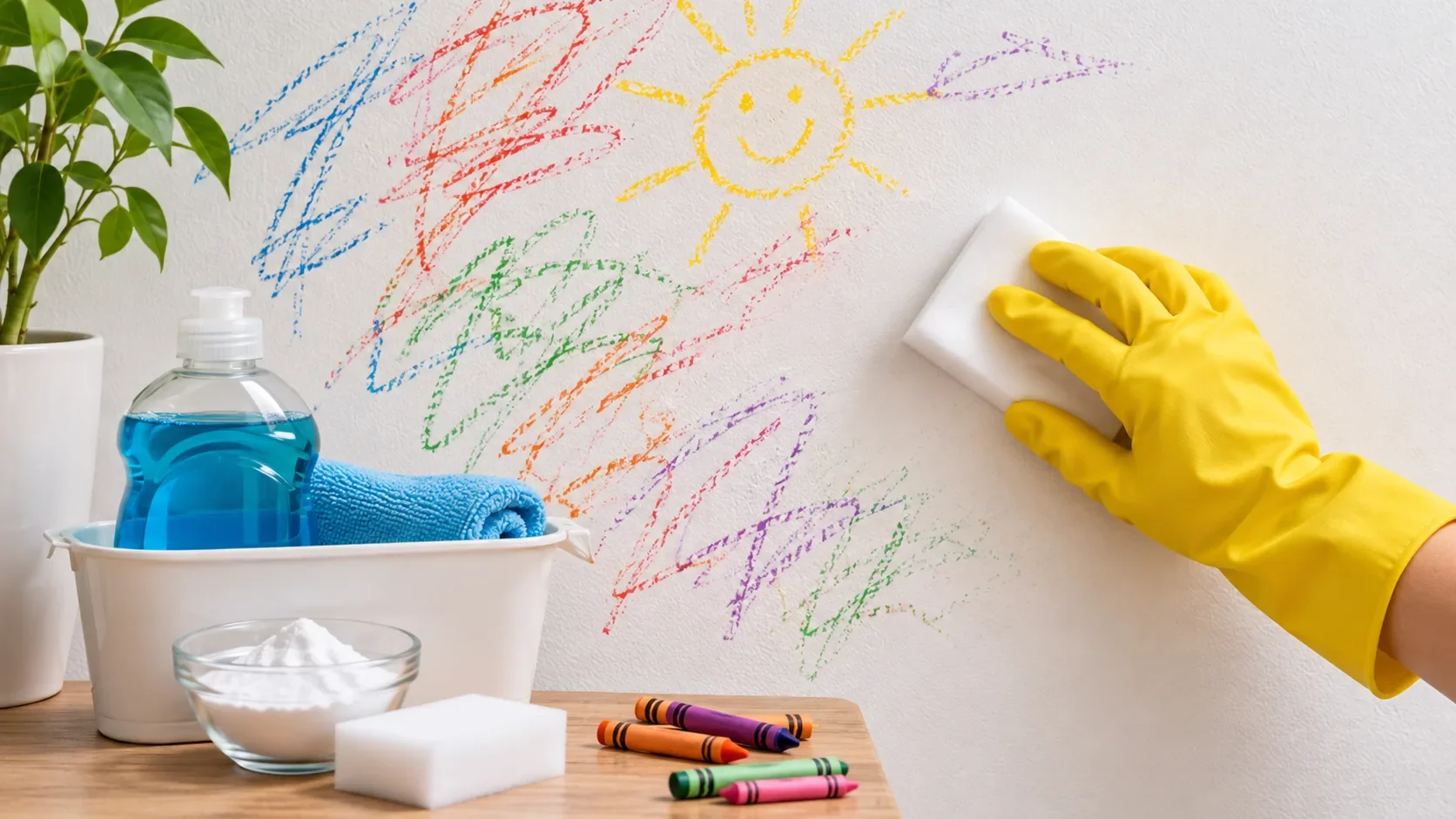
You turn around for a minute. When you look back, there's a bright crayon masterpiece across the wall. Now you're wondering how to get it off without taking the paint with it.
Good news: many crayon marks can come off with a soft cloth, warm water, and a little dish soap. The trick is to start gently, test first, and stop if the paint changes. Here's how to choose the next step without spending all afternoon scrubbing.
To remove crayon from painted walls: Test a hidden spot. Mix a few drops of mild dish soap into warm water. Wring out a microfiber cloth, gently wipe the crayon, then wipe with a second cloth dampened with plain water and dry. Repeat gently if it's helping. On flat or matte paint, use very little pressure. If paint transfers or the sheen changes, stop.
Before You Start: Check Your Paint
Crayons contain wax and color pigments. The wax can cling to the paint, while rubbing too hard can change how the paint looks. A flat wall may develop a shiny patch even when the crayon disappears.
Check the paint maker's cleaning directions if you know the product. Sherwin-Williams advises waiting at least two weeks after painting before using water or cleaner in its guide How to Clean Newly Painted Walls. Your particular paint may require a longer wait, so check its label and care instructions. Whatever the finish, test your method in a hidden spot and let it dry before judging the result.
Gather these supplies
- Two clean, soft microfiber cloths
- Warm water and a few drops of mild dish soap
- A dry towel
- Optional: a cleaner specifically labeled for your type of painted wall, if the gentle method fails
Keep cloths damp, not dripping. Never mix cleaning products.
How to Get Crayon Off Walls: Step by Step
- Dust first. Use a soft dry microfiber cloth or a vacuum dust-brush attachment to remove dust and loose debris. Gently lift loose wax flakes; don't scrape the wall.
- Mix a mild solution. Add a few drops of dish soap to a bowl of warm water. You want lightly soapy water, not a thick layer of suds.
- Test a hidden spot. Wipe gently, rinse, dry, and check for color transfer or a change in sheen.
- Wipe the crayon gently. Dip a soft cloth into the solution, wring it out well, and work on a small section with light pressure. Don't scrub harder if the mark resists.
- Remove the soap. Use a second, lightly damp cloth with plain water.
- Dry and inspect. Pat dry with a clean towel. If the mark is fading and the paint looks unchanged, you can repeat gently. If not, use the troubleshooting guide below.
This is a cautious starting method, not a guarantee. Crayola's stain-removal guidance also describes dish soap and warm water for regular crayons on painted walls and advises testing first.
Which Method Is Safest for Your Paint Finish?
The same cleaning method can leave different results on different walls. If you're unsure what finish you have, treat it as delicate until you know more.
| Paint finish | Best first move | Biggest concern |
|---|---|---|
| Flat or matte | Barely damp soft cloth; minimal pressure | Shiny spots, color loss, burnishing |
| Eggshell | Gentle diluted soap; spot test | Visible rubbing or uneven sheen |
| Satin | Gentle diluted soap; rinse and dry | Scuffs from abrasive tools |
| Semi-gloss | Gentle diluted soap; rinse and dry | Scratches or dull patches |
| Unknown | Start as though it is flat paint | Unexpected finish damage |
Flat or matte walls need extra care. If a mark won't lift with gentle cleaning, matching touch-up paint may look better than repeated rubbing. More washable finishes often tolerate routine cleaning better, but no finish is immune to damage.
Which Crayon-Removal Methods Have Actually Worked?
Real-world tests help show what can work, but they don’t prove that a method is safe for every painted wall. In a 2023 experiment, Marie at My Silly Squirts tried ten approaches on her white wall. She reported that a Magic Eraser was the quickest and easiest; dish soap, toothpaste, a pencil eraser, and baking soda also worked to varying degrees. Vinegar, glass cleaner, mayonnaise, Simple Green, and steel wool were disappointing or problematic in her test.
In a separate Business Insider firsthand comparison, baking soda removed most of the crayon, but faint lines remained; the pencil eraser and mayonnaise did not perform well. Those differing outcomes are a useful reminder that crayon type, paint formulation, wall texture, and technique matter.
| Method | Reported results | Our paint-safety guidance |
|---|---|---|
| Diluted dish soap | Worked in the My Silly Squirts test; also consistent with general painted-wall care guidance | First choice on paint approved for washing; spot-test, use little water, rinse and dry |
| Magic Eraser | Fastest in one homeowner’s test | Abrasive; may change sheen or remove paint. Not our default, particularly on delicate finishes |
| Baking soda paste | Helped in both firsthand comparisons, with differing effectiveness | Sherwin-Williams describes it as a spot-cleaning option for scuffs or stains, but friction can damage paint. Test and follow paint instructions |
| Pencil eraser | Worked slowly in one test; failed in another | Rubbing can mark the finish; not reliable for large areas |
| Toothpaste | Worked in one homeowner test | Some formulas contain abrasives; not a preferred paint-safe first step |
| Disinfecting wipes | Clorox recommends its disinfecting wipes for crayon on surfaces | Check wipe labeling and specific paint compatibility first; this is not a blanket recommendation for painted walls |
| WD-40, mayonnaise, strong solvents | Mixed anecdotes; oily residue is a concern | Avoid as default choices; added residue can complicate cleaning |
Our recommendation: prioritize the finish over the fastest reported result. Start with the gentlest method your paint maker permits, and stop if you see color transfer, a change in sheen, or softening paint.
Why does the same trick work for one person but not another?
Not all crayons are formulated alike, and not all painted walls are equally washable. Regular, washable, and specialty crayons may behave differently. Paint sheen matters, but so do the specific coating, its age, and whether the finish is designed for scrubbing. Even a washable flat paint can behave differently from a delicate flat finish.
What If the Crayon Won't Come Off?
Maybe the soap just smeared the color. Maybe you've already tried a Magic Eraser. Before you grab a stronger product, use this quick guide.
| What's happening? | What to do next |
|---|---|
| The mark is fading | Repeat the gentle soap method once more, using a clean section of cloth. Rinse and dry. |
| Crayon is smearing | Stop rubbing. Replace the soiled cloth, use a little diluted dish soap, and work in small sections without spreading the wax. |
| Soap doesn't help | Check the paint maker's directions. Consider a product explicitly suitable for that finish, test first, and follow its label. Touch-up may be safer. |
| There's oily residue | Don't add more oil. If the paint permits washing, test gentle diluted soap, rinse lightly, and dry. Some stains may need repair. |
| The paint looks shiny, dull, lighter, or starts coming off | Stop immediately. More cleaning can make the patch larger. Consider a paint touch-up. |
| Paint bubbles or peels | Stop using heat, moisture, or cleaning products. Let the area dry and assess repair needs. |
Find Your Safest Next Step
Not sure what to try next? Choose your wall type and what happened. This guide gives you a practical next step—and tells you when to stop.
Your next step
Start with a gentle test
Test a hidden spot with a barely damp microfiber cloth and diluted mild dish soap. Rinse lightly and dry. If the finish changes, stop.
Avoid: Heavy scrubbing, abrasive sponges, solvents, and heat.
This guide is general information, not a test of your specific paint. Follow the paint or wall-covering manufacturer's care instructions when available. Always test first.
Do WD-40, Magic Erasers, and Baking Soda Work?
Online discussions are full of quick fixes. Some people report success. Others end up with grease, scuffs, or damaged paint. A method that removed someone's crayon isn't proof that it is safe on your wall.
WD-40
Some homeowners say it lifts stubborn crayon. But it can leave oily residue, and suitability depends on the painted surface. We don't recommend using it as the default method. If you've already used it, avoid adding more and follow your paint manufacturer's cleaning guidance.
Magic Eraser or melamine sponge
Melamine foam is mildly abrasive. It may remove crayon, but it can also rub away or change paint sheen. If your paint manufacturer permits it, test in a hidden spot and use very light pressure. Avoid it on delicate flat or matte finishes.
Baking soda
A damp cloth with baking soda removed most marks in a Business Insider firsthand comparison, but the author still saw faint lines. Baking soda is abrasive and can alter paint, especially flat or matte finishes. It isn't our first recommendation.
Hair dryers, irons, and strong solvents
Skip hot irons and aggressive heat on painted walls. Heat can soften crayon wax, but it can also damage paint; one homeowner in a Reddit discussion reported bubbling paint after using a hair dryer. Strong solvents and harsh cleaners may also harm the finish. Don't use a product unless its label and your paint's care instructions support it.
When Should You Touch Up the Paint Instead?
If the crayon remains after gentle cleaning, or the wall develops shiny patches, missing color, peeling, or bubbles, more scrubbing can make the repair larger. Let the wall dry and assess whether a paint touch-up or professional repair is the better next step.
Sherwin-Williams recommends using paint from the original can when possible, matching both color and sheen, and using a small roller for a previously rolled wall or a brush for a previously brushed area. Touch-ups can still show, especially when the existing paint has aged. For a large or damaged area, ask a painter whether repainting the section or wall will blend better.
What If Your Child Covered an Entire Wall?
A few scribbles are one thing. A rainbow mural from the baseboard to the light switch is another. The goal is to avoid turning a small cleanup into a full wall repair.
- Test one small area first. Don't apply a product to the whole wall until you know how the finish responds.
- Work in sections. Clean one small area, rinse, dry, and inspect before moving on.
- Switch cloths often. A cloth loaded with crayon wax may spread color instead of removing it.
- Take breaks. Repeated friction can damage paint even when each pass feels gentle.
- Know when repair is simpler. If large areas won't clean safely, matching touch-up paint or repainting may be more practical.
And if this happened while you were making dinner, answering work messages, or caring for another child? You're not the only parent who's dealt with surprise wall art. The important thing now is finding a sensible fix.
How to Make the Next Crayon Cleanup Easier
Keep washable crayons available when appropriate, offer plenty of paper, and consider an easel or designated art space. Washable doesn't mean every mark will disappear from every wall, so check the crayon manufacturer's instructions.
For the rest of the house, a realistic routine can help keep small messes from piling up. Our guide to keeping up with housework when working full-time offers practical ways to reduce the load.
When Professional Cleaning Makes Sense
Removing stubborn crayon isn't always a routine house-cleaning task, and professional cleaning can't repair damaged paint. Ask about any wall spot-cleaning needs before booking rather than assuming they're included.
But if the crayon is just one more thing on a long household list, help with the everyday cleaning may give you time back. Tres Maids offers recurring house cleaning in Westchester County and one-time house cleaning. If you're deciding what kind of service makes sense, see our guide to regular cleaning versus deep cleaning.
Wondering whether hiring help is worth it? Read is a house cleaning service worth it? for a practical look at the trade-offs.
Frequently Asked Questions
How do you get crayon off walls without removing paint?
Start with a hidden spot test, then use a soft cloth dampened with diluted mild dish soap. Wipe gently, remove soap with a second lightly damp cloth, and dry. Stop if the paint changes color or sheen.
Can you remove crayon from flat paint?
Sometimes, but flat paint can show rubbing. Try only a barely damp cloth and minimal pressure. If gentle cleaning fails, touch-up paint may be the safer choice.
Does a Magic Eraser remove crayon from walls?
It can, but melamine foam is abrasive and may damage paint. Test first, use light pressure only if the finish permits it, and stop at the first sign of change.
Can I remove crayon from a wall painted last week?
Sherwin-Williams advises waiting at least two weeks before wet-cleaning newly painted walls. Follow the specific paint product’s instructions; some coatings need longer. Avoid scrubbing fresh paint.
Are washable crayons always easy to remove?
No. Washable describes the product’s intended cleaning characteristics, not a guarantee for every painted surface. Follow the crayon maker’s stain guidance and test the paint first.
What about non-Crayola or specialty crayons?
Results vary by crayon formula and paint finish. If the mild method fails, don't assume more pressure is the answer. Check product guidance and consider a paint touch-up.
Can you clean crayon off textured walls?
It may be harder because color settles into grooves. Use a soft cloth or sponge without hard scrubbing. Avoid soaking the texture or damaging raised areas.
Should I use a hair dryer to melt crayon?
We don't recommend heat as a first-line method. It can affect paint and may spread softened wax. Hot irons are especially risky on painted walls.
When should I repaint instead of cleaning?
Consider touch-up paint when gentle methods fail or cleaning changes the wall's color, texture, or sheen. If paint is peeling or bubbling, stop and address the surface damage first.
The Easiest Fix Is the One That Protects Your Wall
Start with diluted dish soap, a soft cloth, and a small test area. If the crayon lifts without changing the paint, keep going gently. If it doesn't, don't turn up the pressure. Sometimes the best fix is a small paint touch-up.
And when you're ready to spend less of your free time on the rest of the house, Tres Maids can help you explore a cleaning routine that fits your home.
More time for life. Less time cleaning.
See what professional home cleaning could cost for your space.
See My Cleaning PriceNo payment required to see your estimate.
Sources and further reading
Paint care: Sherwin-Williams, How to Clean Newly Painted Walls (Just for Starters guide, pp. 1–2; wait at least two weeks, use mild soapy water, rinse, spot-test, and match paint for touch-ups). Cleaning experiments: Marie, My Silly Squirts, “I tested 10 ways to remove crayon off walls. Here’s the best one” (Aug. 16, 2023); Jennifer Polland, Business Insider (2017), firsthand crayon-removal comparison. Product guidance: Clorox, How to Get Crayon Off the Wall and Out of Clothes (general surfaces; confirm product compatibility with paint). These sources describe different settings and do not establish universal paint safety.
Crayola: Stain Removal Tips (regular crayons on painted walls); Tres Maids: How to Find a Good House Cleaner. Product instructions and paint care recommendations should take priority over general tips.